Nest box season 2025: what worked and what didn't
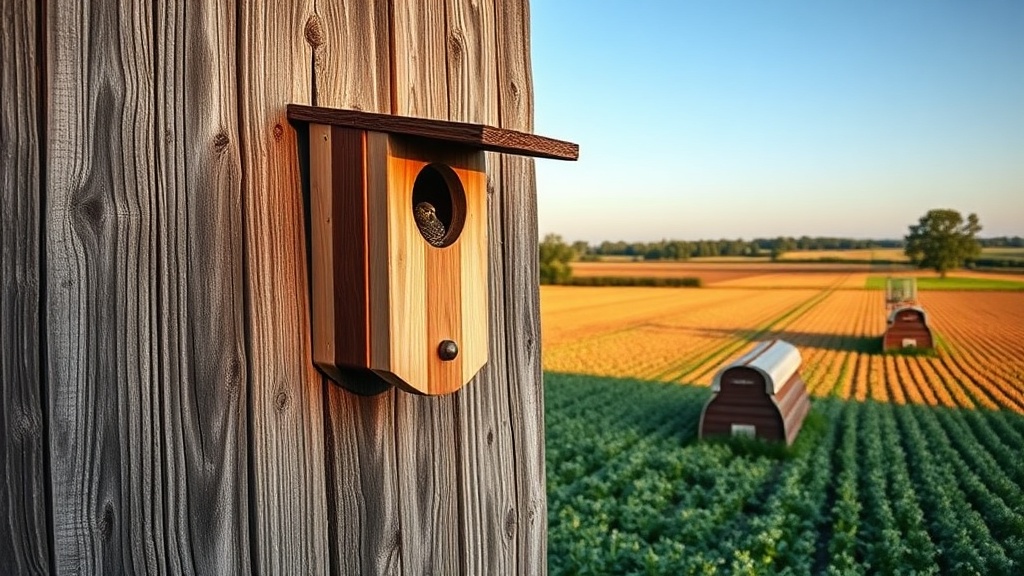
I ended the 2025 season with four nest boxes monitored and a mixed result. Two successful broods (12 chicks fledged total), one abandoned clutch, and one box completely taken over by stock doves before any kestrel pair could claim it. Some of this I could have prevented. Some of it I couldn't.
I started the nest box programme in 2023 with two boxes and an agreement with two farmers in the Hoeksche Waard. The idea was straightforward: kestrels in this part of South Holland are cavity-limited, meaning there are enough voles to support more breeding pairs than currently nest there, but not enough suitable nest sites. Boxes change that equation, at least locally.
Box by box
Box A — Westmaas farm barn, south wall, 6m height
Occupied from late March. Female laid five eggs, four hatched, four fledged. Best result of the season. This box has produced a brood every year since installation. The orientation (south-facing, barn wall, open field view to the southwest) appears ideal — the female can watch the hunting territory from the entrance hole and I can watch from the access lane 80m away without disturbing her.
Box B — Numansdorp, barn gable, north-facing, 7.5m height
Occupied late April, which is late. Female laid four eggs, three hatched, three fledged. The north-facing orientation concerns me — chicks in a cold spring would struggle without solar warming of the box, and April 2025 was colder than average. The farmer would be willing to move it if I build a replacement. I'll probably do this over winter.
Box C — Strijen, free-standing pole, 5m height, field boundary
This is the one I'm most frustrated about. A pair investigated repeatedly in March — I watched the male going in and out of the entrance hole five times over two days. Then nothing for two weeks. In mid-April I found the box occupied by a stock dove pair, which had brought in enough material to block the entrance partially. The doves fledged two young in June. Kestrels don't evict doves once they're established.
The error was the entrance hole size. I built this box with a 70mm hole diameter following a guide I found online. Kestrels prefer 65-68mm, and at 70mm the hole was large enough for stock doves to enter easily. New box over winter with a 65mm hole and a proper anti-dove baffle below the entrance.
Box D — Oud-Beijerland, church tower, 12m height (permission from municipality)
This was the ambitious one. Getting permission from the municipality took from November 2024 to March 2025, by which point the season was already starting. No kestrel occupancy in the first year, which wasn't surprising. Church tower boxes typically take 2-3 years to attract a pair. I'll check again in February 2026.
What I've learned about placement
South or southeast facing is strongly preferable, especially for early-season clutches when ambient temperature matters for incubation. A view of open ground from the entrance — not blocked by trees or other structures within 20m — appears to help with adoption. Height above 5m seems more important than the exact number; I haven't seen a meaningful difference between the 6m and 7.5m boxes.
The most important factor I consistently underestimated early on: proximity to good vole habitat. Box C in Strijen sits at the boundary of an intensively managed arable field that gets ploughed twice a year. Vole populations there are suppressed by the disturbance. I put the box there because the pole location was convenient. That was a mistake. Good habitat within 500m of the box matters more than anything else.
Plans for 2026
- Replace Box C with correct hole diameter and add dove baffle
- Rotate Box B to south-facing, which requires moving to a different section of the barn with the farmer's agreement (he's fine with it)
- Add a fifth box near Goudswaard where I've seen a hunting pair every winter for three years but have never found a nest site
- Consider a trail camera on Box A to get activity data without disturbance visits — the farmer has suggested this and I'm looking at options
If you're interested in running a nest box scheme in South Holland or Zeeland and want to compare notes, the email is on the about page. Vogelbescherming Nederland also coordinates a national programme if you want to contribute data formally.